Click on Picture to Link to Youtube

Click on Picture to Link to Youtube
Click on Picture for The History Channel

Thursday, July 13, 2006

INSO Monthly Newsletters Episodes 1-3

INSO Monthly Newsletter
December, 2001
Episode 3

(*_*) (*_*) (*_*) (*_*) (*_*)

In this episode:

1. News
2. INSO Tour Update by Denis Morrison [Sponsor in Seattle]
3. 'History of Music Documentation in Iraq' by Bassim H. Petros [W/E Team]
4. 'History of the INSO - Part II' translated into English by Wafaa' Al-Natheema [W/E Team]

(*_*))))))))))(((((((((((*_*)


1. NEWS:

* We are pleased to announce that Jason Carter, a Spanish guitar player from Britain, has joined our writing/editing team.

Jason Carter plays a fusion of flamenco, jazz and classical guitar. He was trained under John Williams and Paco Pena at the Royal Academy of Music in London. Some of his solo performances took place in Bahrain, Belgium, Finland, France, Holland, India, Ireland, Saudi Arabia, United Arab Emirates and the USA. Jason played with the Orchestra of the Royal Marines, New Irish Orchestra, Belgium Radio Choir and others. He co-founded the ‘Bahrain International Guitar Festival.’ This year Jason received a Music Award from the Crown Prince of Bahrain alongside four Arab Artists. In 2001 he performed the ‘Concerto de Aranjuez’ to celebrate the centenary of the composer’s life, Joaquin Rodrigo. This was performed in Finland, Ireland and the UK. He has also recorded ‘Boccherini Guitar Quintets’ with the Bingham String Quartet.

* Fawzi Habboushe [subscriber], music director and conductor of the Philadelphia Doctors' Orchestra, has participated in a workshop focusing on conducting in the Czech Republic between Nov 29 and Dec 9. The activities included rehearsals of Beethoven symphony # 2, Rimsky-Korsakov's Capriccio Espaniole, Copland's Outdoor Overture, DeBussy's Afternoon of a Faun, Strauss's Polka and Donna Diana's Overture of Resnicek. A concert with the Karlsbad symphony orchestra concluded the workshop.

----------------------------------------------


2. INSO Tour Update from Seattle by Denis Morrison

We are still looking for someone who can write a grant proposal to solicit funds for the INSO project. Currently, we have no funds to pay for a grant writer so that person would have to be able to look at including his/her fee within the grant proposal itself. Our hope initially wasto find someone with that skill to donate that ability.

As a side effort to the funding, a draft letter was sent to Hans Von Sponeck, former UN Humanitarian Aid Coordinator to Iraq; which if he agrees to its content, it will be sent to the two Washington State Senators asking for their support of the INSO project for Seattle. While visiting in Seattle, Mr.Sponeck was presented with the background of our intent with the INSO project and he was extremely supportive of the idea. He requested the draft letter be sent to him and we're hoping that he finds it acceptable.
_________---_____________---_______

3. 'History of Music Documentation in Iraq'
by Bassim H. Petros [W/E Team]

For over three decades, the Iraqi media (press, periodicals, TV and radio) have contributed in the publishing of musical articles and journals. Among the leading writers were:
1 Asa'ad Mohammed Ali, 2 Abdul Wahab Belal, 3 Adel El-Hashimi, 4 Abdul Wahab El-Sheikhli,
5 Soua'd El-Hermizi, 6 Bassim H. Petros, 7 Hussein Qaddouiri, 8 Hamdi M. Saleh, 9 Hameed Yasin.

During the 1980s and 1990s, writers such as Tarek Hassoon Fareed and Adel Al-Hashimi became among the major contributors in the music documentation process. For the INSO concerts and relevant program literature booklets, the major contributors were Ghazi Mustafa Bahjet, Mazin El-Zahawi, Munther J. Hafeth, Bassim H. Petrosand Hamdi Qaddouri. The World of Music, the first TV program of its kind,was established in 1974, as a weekly one-hour program, by both Munther J. Hafeth and Bassim H. Petros. They both hosted it for over a year, and then was continued by Father Phillip Helayee (Music Scholar), Abdul Razaak Al-Azzawi and Tarek Hassoon Fareed. During the second half of the 90s, Sultan Al-Khateeb (a young pianist, graduated from the Music and Ballet School, Baghdad) and Ali Abdul Amir (a journalist) hosted another musical TV program called 'Music Music'.

Musical conferences and festivals were regularly held and/or hosted in Baghdad, and other towns in Iraq. The National Symphony Orchestra used to give concerts in Baghdad, Mosul, Kirkuk, Erbil, Suleymania, Nassiriya and Basra with lectures presented prior to many of the performances. Special concerts were organized for Students Summer Popular Work Camps, universities and disabled rehabilitation centers.

Al-Kithara, Music and Children: Monthly magazines were published in 1975 by the Musical Arts Department of the Ministry of Culture and Information. Al-Kithara's Editor-in-Chief was Munir Bashir. Bassim H. Petros (currently living in NZ) was the magazine's editor and Munther J. Hafeth and Hussein Qaddouri (both living in Iraq) were its editing team. The Arabic Music Magazine (of the Arab Academy of Music "Al-Majma'a Al-Arabi Lil-moseeqa" of the Arab States League) was published in 1982. The first six issues were edited by the late Dr. Sinan Sa'eed. Then continued to be edited by Bassim H. Petros with Munir Bashir as Editor-in-Chief. The first 11 issues of the Arabic Music Magazine were published and printed in Baghdad. Later, four other issues were published outside of Iraq:

* One published in Sudan (studies on the Pentatonic Music),

* Another issue published in Morocco, and

* Two issues published in Syria..


Since 1997, the magazine has been published in Amman (where the Academy's new Secretary General Kifah Fakhouri). Five issues were released since then.National and international musical conferences and festivals were regularly held and/or hosted in Baghdad, which were organized and sponsored by the Iraqi National Music Committee of the International Music Council - Unesco. The committee was composed of Munir Bashir (president), Munther J. Hafeth (vice-president), Bassim H. Petros (secretary general), with other music documentors such as Hussein Qaddouri, Dr. Subhi Anwar Rashid and others.As a result, the musical culture gained an adequate level of documentation in Iraq, third after politics and sports, which is perhaps a common rank of subject importance worldwide.

(**************)

4. 'History of the INSO' by Wafaa [W/E team] Part 2
Mostly based on documents published by the Ministry of Culture and Information, and made available by Bassim H. Petros
-*-*-*-*-*-*-*

In 1959, the Orchestra became officially known as the IRAQI National Symphony Orchestra (INSO), whereby musicians began to earn monthly stipend. Before that year, all musicians used to perform on a volunteer bases. Due to Iraq's instability during the 1960s, the Orchestra was shut down a couple of times.

In 1971, it was reopened and continued its activities and performances till the present day.Since its establishment in the 1940s, the INSO has had twenty-two (Iraqi and foreign) conductors (their names will be enlisted in future issues)

The Orchestra did not just perform classical pieces by European composers, it had also played symphonic compositions by Iraqi musicians. Among them were Farid Allahwerdi, Munther J. Hafeth, Munir Bashir, Hanna Petros, Khalil Ismael, Beatrice Ohannissian, Agnes Bashir, Hussein Qaddouri, Mohammed Ra'oof and others.

To be continued............


-------------------------------------------------------------------
The INSO Writing/Editing Team:
Munir Allahwerdi, Clarinet Player (INSO) [Austria]
Jason Carter, Guitarist [UK]
Munther J. Hafeth, Composer, Musician (INSO) [IRAQ]
Nahla Jajo, Violinist (INSO) [IRAQ]
Andrew Jones, Violinist, Journalist [South Africa]
Salem A. Kareem, Composer & Oud player [UAE]
Beatrice Ohanessian, Composer, Pianist (INSO) [USA]
Bassim H. Petros, Cellist, Music Critic (INSO) [New Zealand]
Wafaa' Mahmood, List Moderator & Concert Tour Organizer [USA]
^^^^^^^^^^^^^^^^^^^^^^^^^^^^^^^^^^^^^^


INSO Monthly Newsletter

November, 2001

Episode 2

(*_*) (*_*) (*_*) (*_*) (*_*)


In this episode:

1. News

2. 'A Violin & A Trip' by Andrew Jones [W/E Team]

3. History of the INSO translated into English by Wafaa' Al-Natheema [W/E Team]

4. Inquiry about M. E. composers by Nabil Azzam [Subscriber]

----------------------------------------------------------------------------

1. News

* Recently, we learned that Iraqis are now able to get on the Internet in the convenience of their home or office, something that was unavailable before. We received our first email three days ago from Nahla Jajo in Baghdad, a violinist and one of INSO's writing/editing team. We were informed by her that the INSO just gave a performance in October. We await her report about the concert. The availability of the email service in Baghdad will make it easier for us to receive their reports, news and articles, not to mention it enables us to organize better for the tour.

* We are proud to announce that the famous Iraqi pianist and composer, Beatrice Ohanessian, had just joined our writing/editing team. Until we receive her credentials and article in December, we will introduce her with a brief background provided by BassimH. Petros:
Beatrice Ohanessian was born in Baghdad in 1930, where she started her early piano training at the age of 7. In 1937, she entered the Music Institute where she was accepted regardless of her age condition. She studied there all through 1944 under Prof. Julian Herts (Romanian). Upon graduation in 1944, she was appointed as piano teacher at the Institute of Fine Arts. On a scholarship grant, Beatrice proceeded with higher studies at the Royal Music Academy in London. Ms. Ohanissian was granted another scholarship to study at the Juliard School of Music in New York. Stay tuned for more.
-----------------------------------------------------------------

2. 'A Violin & A Trip -- Performing in Baghdad'

By Andrew Jones


It’s hard to remember the day, but I know it was hot in downtown Baghdad. I had found out about the Iraqi National Symphony Orchestra (INSO) through my association with Layla Al-Attar, who was the Director General of Arts.

In 1993, Ms. Al-Attar and her husband were at a family member's house when they were killed by a cruise missile. Their house had been hit in January 1991 and destroyed. But at that time, they weren't home. Layla made a phone call and got me an invitation to a rehearsal. I was looking forward to it eagerly and would have been even more eager had I not lost my violin on the way over from the States. As it happened, my Lufhansa flight to Frankfurt and Rome had left early because of thunder storms. I had had my violin repaired. Unfortunately my partner was bringing it to the airport from the repair shop when he got stuck in traffic. So my violin missed the flight. He sent it via the next flight but that one was late because of the same group of storms. So by the time it arrived, my connecting flight had left already. So there I was about to take a video of the INSO and all I could think of was that my violin wasn't there with me. I remember they were playing Tchaikovsky’s Serenade for Strings, a piece my own ensemble in the States had performed. They played very well.

After completing their rehearsal, one of the musicians approached me and started asking me questions. Yes, I am a musician, I said. My instrument?, the violin. He immediately grabbed one of the violinists, and spoke to him in Arabic. After which the young man politely handed me his violin. Now I didn't know everyone was watching this until I put my camera down, took up the instrument and this huge silence came over the hall. First, I played theA and E strings to see how well in tune they were. I sharpened the A string a bit to create perfect fifths. Because I changed the tuning of the A string, I had to raise the pitch on the D and G strings. Then, I listened again to all four strings and decided that they were in tune. I played a four octave D major arpeggio and a bit of Bach. When I finished all musicians applauded. Later I was able to perform in concert with the Baghdad Chamber Music Ensemble, a group made up of the principal players in the INSO.

In rehearsals as well as during our concert at the Saddam Arts, to say they played me into the dirt is an understatement. The concertmaster, Aram Zarassian, had studied in Russia and so had the cellist and a few of the others. Their training had been first rate and their playing was masterful whereas my performance was competent at best. But I was pleased for having the chance to do something other musicians wouldn't have had the chance to do so, perform in Baghdad at the Saddam Arts Center. Ms. Al-Attar and her husband attended the concert and they both were proud of me and their own musicians.

After the concert, I promised the musicians that I would help them come to the States and perform. Little did I know how difficult that was to accomplish here in the States, but I never forgot that promise. Now that I live in South Africa, I can and will do my best to arrange for them to tour here. I did eventually recover my violin in the lost and found department at Lufthansa Airlines in Frankfurt. The agent swore they didn't have it, but I insisted they did. After two hours of arguing and searching, I found it. Having survived such circumstances, I am interpreting this as some kind of an omen for what lies ahead. I took it as a sign and intend toplay it with members of the INSO when they come to South Africa.

-----------------------------------------------------------


3. History of the Iraqi National Symphony Orchestra (INSO) Part 1

Translated to English by Wafaa' Al-Natheema

From documents published by the Ministry of Culture and Information, compiled and made available by Bassim H. Petros


The Music Institute was established in 1936. It was then when music lovers began to meet at the Institute to listen to classical music both live and recorded. Five years later, The Music Institute was renamed the Institute of Fine Arts whereby a Chamber Orchestra formulated. The Orchestra,which consisted of string instruments, gave its first performance in 1941.

It was conducted by Hanna Petros at the Royal College of Medicine.In 1948, The Baghdad Philharmonic Society was founded in affiliation with the Institute of Fine Arts. This Society, then, formed the Baghdad Philharmonic Orchestra, which was composed of volunteers. The Orchestra gave three performances; two in Baghdad at the hall of the Institute of Fine Arts and at the King Faisal Hall, and a third in Kerkuk (North of Iraq).


In 1959 during the leadership of Prime Minister Abdul Karim Qasim, the Orchestra became officially known as the IRAQI National Symphony Orchestra (INSO). It was then when it became an official-paid Orchestra and continued so to this day.

To be continued......................

---------------------------------------------------------------------


4. Inquiry about Middle Eastern Composers [Please respond to Nabil Azzam directly regarding his inquiry and CC it to our address, so that we share the information with the list.]"

Greetings: I wonder if you have any printed material regarding symphonic works by composers from the Middle East. I am very much interested in the subject since I work with Mesto (an orchestra based in Los Angeles) Best, Nabil Azzam" Azzamv@aol.com

-------------------------------------------------------------------


The INSO Writing/Editing Team:

Munir Allahwerdi, Clarinet Player (INSO) [Austria]
Munther J. Hafeth, Composer, Musician (INSO) [IRAQ]
Nahla Jajo, Violinist (INSO) [IRAQ]
Andrew Jones, Violinist, Journalist [South Africa]
Salem A. Kareem, Composer & Oud player [UAE]
Beatrice Ohanessian, Composer, Pianist (INSO) [USA]
Bassim Hanna Petros, Cellist, Music Critic (INSO) [New Zealand]
Wafaa Mahmood, List Moderator & Concert Tour Organizer [USA]
----------------------------------------------------------------

INSO Monthly Newsletter
October 26, 2001
Episode 1

(*_*) (*_*) (*_*) (*_*) (*_*)

In this episode:
1. Remarks by Bassim H. Petros [Writing/Editing (W/E) Team]
2. Article by Munir Allahwerdi [W/E Team]
--------------------------------------------------------------------------

1. Remarks on the INSO and Classical Music for Brainstorming
By Bassim H. Petros

The objective of the writing team for the INSO list is to introduce the Iraqi National Symphony Orchestra's history, music and activities. In doing so, I would like to point out the following:

1. There is no western symphonic music in musicology; this type of music is unique. Therefore it’s sufficient to refer to it as symphonic music.

2. The INSO was the fruit of collaboration, it did not materialize due to a single person's initiative.

Should we seek to lay a case study about the INSO, I would suggest:

1 Few lines of INTRODUCTION: Symphonic Music in Iraq.

2 The Role of the Music Institute (1936 – 1940) in the formation of Classical Music Groups (Bands, smaller groups, solo players, etc.),

3 The founding stone of the first (string) orchestra introduced by the Fine Arts Institute before 1946, which presented its very first, but only one, concert at the Royal College of Medicine in
Baghdad (according to available documentation).

4 Then reaching the solid phase starting from the Baghdad Philharmonic Society (as an orchestra comprised of volunteers), to the Iraqi National Symphony Orchestra as an official-paid orchestra, which is still so to this very day.

Musically, we need to focus on the literature presented by
the INSO, including Iraqi and Arabic music specially composed
and presented by the Orchestra.
------------------------------------------------------------------

2. THE IRAQI NATIONAL SYMPHONY ORCHESTRA/1946-1951
A Personal Account
By Munir Allahwerdi

Munir, for heaven´s sake let us stop this “Monkey Business” (somehow some friends took me as a focal point in matter related to the Orchestra.)

With countless number of complaints, I was asked by friends at the Fine Arts Institute to leave them alone and refrain from persuading them to come to an orchestral rehearsal. They complained because I was putting them on the spot; making a difficult choice of either saying NO to a noble idea or agreeing to continue with the frustration of having to come to rehearsals without the basic ingredients of an orchestra. Eligible players for certain instruments did not even exist in Iraq and recruiting them from abroad by the Government was not financially feasible. No real orchestra was in sight.

But we don´t have an oboe player! "Well," I said, "I can play the solo oboe part on my clarinet when the clarinet part is not so important and it could be easily sacrificed." The idea was to
introduce symphonic music live to the Iraqi public which was unavailable to them. By symphonic, I mean orchestral diversity; strings, woodwinds, brass and processions. Who would care if instead of oboe a theme is played on the clarinet? So I would play the opening themes in both movements of Schubert´s Unfinished Symphony on the clarinet instead of oboe and when
that should be followed by the solo clarinet, it is me again on the clarinet itself.

But we don´t have a Bassoon player! "Come on fellows, that is very easy," I said, "I will play the Bassoon solo opening passage for Haydn´s Symphony "The Clock" on the lower register of my clarinet which sound´s quite like Bassoon." I also told them that there is no need to worry anymore. The army has just discharged a player from its Royal Guards Band into retirement and we could hire him for the job at the Institute as an “Office Boy”. He plays the Euphonium (a small Tuba). He shall be able to play the Bassoon parts on the
Euphonium. "Just be patient!"

But you, Munir, are doing all of this in order to enjoy the opportunity to play all the solo passages and have us the string players accompany you one viola player concluded. Of course I enjoyed playing the solo parts. Why do we play music anyway? By then, a glimpse of hope for real woodwind players to join us appeared on the horizon. During my coffee breaks while working as an engineer at the British firm Stephen Lynch, I visited my friend Arshak who had a tailoring shop on Rasheed Street. In that shop, a man sitting quietly on a chair busy mending holes in used clothes, was introduced to me as a talented flute player. His name was Dikran Kousoudjian. I proposed that he comes to our next rehearsal. He was grateful for the pleasure of playing and didn't mind that it was compensation free. Dikran turned out to be an excellent professional musician (Flutist) who, according to rumors, fled Cyprus to hide in Iraq. With Dikran, the orchestra got a quantum jump ahead.

In a similar way, I enlisted a Spanish contrabass player named Valieri who was a music Academy graduate from Madrid playing with a cabaret band temporarily stationed in Baghdad. He played with us for about a year for free. Both of us used to ride my old Packard car to go to rehearsals. He left Iraq with his Band at the expiration of their residence permit leaving behind his instrument and his pupil, myself, whom he taught also free of charge. We gave him a thank-you gift of 20 Iraqi Dinars for the instrument. The money came from our subscriptions to the Baghdad Philharmonic Society of which I was the Secretary.
I played the contrabass for nearly a year until my good friend and a keen follower of the development of the orchestra, Jawad Selim, decided to act. His wife, Lorna, was already playing second violin occupying the chair next to Fuad Michu. Fuad was always the leader of the second violin section because he was the most reliable in that group with regard to keeping time. Jawad Salim, who was aware of my long term plans to leave Iraq to study abroad, wanted to secure a contrabass player to replace me. Since he played the guitar, we decided that I give him lessons on the contrabass. He learned quickly and did not waste time. We wanted to share our pleasant experiences with our friends and the society. We believed the most effective way would be to have them witness a live symphonic concert, and we did indeed succeed in converting people to music lovers.

---------------------------------------------------------------------

The INSO Writing/Editing Team:Munir Allahwerdi, Clarinet Player (INSO) [Austria]
Munther J. Hafeth, Musician (INSO) [IRAQ]
Nahla Jajo, Violinist (INSO) [IRAQ]
Andrew Jones, Journalist, Violinist [South Africa]
Salem A. Kareem, Composer & Oud player [UAE]
Bassim Hanna Petros, Cellist, Music Critic (INSO) [New Zealand]
Wafaa' Mahmood, List Moderator & Concert Tour Organizer [USA]


(*_*)****(*_*)

The Writing/Editing Team
Biography
As of September 2001


Salem Abdel Kareem, United Arab Emerites (UAE)Born in Baghdad in 1953. Mr. Abdel Kareem is a graduate of theCenter for Musical Studies. He is a Oud player, composer and teacher. Since 1976, he has been given solo performances inside and outside of Iraq. Salem accompanied the Iraqi National Symphony Orchestra (INSO) on the Oudin 1976, 1980 and 1993. He is a composer of more than 250 musical pieces. He established several music groups including the Oud Ensemble, which was comprised of 48 Oud players. His last position before leaving IRAQ was Dean of the Center of Musical Studies. He currently lives,composes and teaches in the UAE.
------------------------------------------------------------------

Munir Allahwerdi, [Former INSO Musician] Austria
Born in Basra, Iraq in 1926. Joined the Fine Arts Institute in Baghdad in October 1942. Performed in many chamber music and orchestral concerts in Iraq as well as on radio and TV from 1945 and on mainly as solo clarinetist and sometimes as contrabassist. Created the first clarinet class and taught the instrument at the Fine Arts Institute. Graduated as civil engineer from the Engineering College and as clarinetist from the Fine Arts Institute in Baghdad 1948. Earned Master's of Science from the State University of Iowa. Worked as the head of the Arab States unit at the UN Financing System for Science and Technology for Development 1980-1985. In 1985, Munir retired in Vienna where he formed a group of chamber music players from various well-known orchestras and performed in Vienna and in Finland.
-----------------------------------------------------------------------

Munther J. Hafeth, [Current INSO Musician] IRAQ
Born in Baghdad, in 1933. He completed his musical studies at the Fine Arts Institute in Baghdad in 1955. Mr Hafeth joined the Viola section of the Institute Orchestra in 1949. He was one of the founding members of the Hydn String Quartet. Munther proceeded with higher musical training in UK in 1950s. With Bassim Petros, he founded the program [World of Music] which aired weekly on Baghdad TV.From 1974 to 1992, he was vice president of the Iraqi National Music Committee of the International Music Council (IMC)He is a member and administration director of the Arab Academy of Music (AMA) of the Arab League and an editorial member of the Arab Music Magazine of the AMA. Mr. Hafeth was leading composer throughout the lst three decades of the 20's century.
----------------------------------------------------------------------

Nahla A. Jajo, [Current INSO Musician] IRAQ
Born in Kirkuk, north of Iraq in 1970. Started her music studies at the Music and Ballet School in Baghdad at the age of six. She received a diploma in music from the same school in 1988. Began playing violin with the Iraqi National Symphony Orchestra in 1992. Nahla has been teaching the violin at the Music and Ballet School since 1994. A member of the Somer Chamber Music from 1994 to 1998 and currently a member of the Baghdad Music Group. In 1991, she obtained a B.S. in architectural engineering from Baghdad University in Iraq. Worked with several architectural engineering firms in Iraq and Jordan. Currently, she is working in interior design in Baghdad as an independent contractor.
------------------------------------------------------------------

Andrew P. Jones, South Africa
Born in Virginia, USA in 1952. He is a graduate of the New England Conservatory of Music and Boston University. As a violinist, Mr. Jones has performed with the Opera Company of Boston, the National Philharmonic Orchestra, the String Reunion in New York, The New Hampshire Symphony and others. He has also performed with famous artists including Stevie Wonder, Lena Horne, Lou Rawls, Tom Jones, Gladys Knight and the Pips and Sammy Davis Jr. A highlight of Andrew's musical career was a 1991 invitation to perform with the Baghdad Chamber Ensemble at the Saddam Arts Centre in Baghdad. He has been a broadcast journalist covering news for ABC, NBC, the BBC, WDR German Television, The Canadian Broadcast Company and other networks in S. Africa and Russia. Currently, he works as a filmmaker and a guest lecturer in Johannesburg, South Africa.
------------------------------------------------------------------
Bassim H. Petros, [Former INSO Musician] New Zealand
Born in Baghdad in 1934. Joined the Fine Arts Institute in Baghdad in 1947 to study 'Cello under Sherrif Muhi_ddin Haydar (Turkish), Hagob Kouyoumidjian (Iraqi) and Adres Taurrer (French) Joined the Baghdad Philharmonic (INSO later on) in 1948 as a Cellist. Established and presented with Munther J. Hafeth the-first-of-its-kind Baghdad TV weekly program (The World of Music). Bassim is a member of the Iraqi National Music Committee (INMC), the International Music Council (Unesco), the Arab Academy of Music (of the Arab States League) and the Iraqi Artists Union. Bassim has been part of Arab music festivals, conferences and rostras. For five years, he worked at the National Music Conservatory in Amman as Cello and Contrabass teacher and as a member of its orchestra and band.
--------------------------------------------------------------------

Wafaa Mahmood, The United States of America (USA)

Wafaa is the moderator of the INSO email list.
Saturday, July 8, 2006

Discussion about Iraqi Jews


The correspondence below provides information on the status of Jewish Arabs in IRAQ (from ancient times through their departure to Israel in the 1950s) and discusses the misconceptions about the subject matter. Those who participated in the discussion are members of the
History of IRAQ Yahoogroup. For better understanding of this lengthy correspondence, please begin reading from the bottom of this post and continue upwards.


**************

Dear Wafaa
This is just a quick response, mainly to address your request for a source on the full original text opf the 1950 law regarding the emigration and rescinding of the citizenship of Iraqi Jews.

Two books that will most probably between them together address your query are (and I am writing this from memory, as I have no access to these books right now, so the books' details will be incomplete and not 100% accurate):

(1)- Prof. Hanna Batatu's classic "The Old Ruling Classes and The Revolutionary Movements in Modern Iraq"; Princeton University Press, 1988 (or thereabouts)

(2)- Abbas Shiblaq's "The Lure Of Zion The Case Of The Iraqi Jews" (published in the UK, in the 1980s) (In both cases, the titles as I have stated them may not be 100% accurate, but very close)

While I do not agree with everything that either of the above two books state (in fact, I and a number of other people have identified some very serious factual errors as well as errors of interpretation in both of them, and conveyed the same to the author of the first one, now deceased, who, after a long fight, conceded these in writing, promising to correct them in the next editions, graciously apologizing to me and the family, also in writing; he did make some, but not all, of the corrections that he had promised us in the Arabic edition) , they do nevertheless constitute some of the most reliable (in some instances highly valuable) sources when it comes to documentation and referencing. (The facts that these two books contain such errors is hardly surprising considering the acute slant in the backgrounds of their respective authors against the old Iraqi regime; Batatu, a Palestinian-Lebanese Christian turned communist, living in the USA, and Shiblaq, a Palestinian Leftist living in the UK; their preconceived notions and hell-bent condemnation of everything that had to do with the Royalist era in Iraq seep through their respective books from cover to cover, although sometimes more subtly than others. The late Batatu's mainstream thesis, thinly disguised, is to promote the cause of the Iraqi communist party, all the way through bemoaning its loss of opportunity to govern Iraq forever).

Another possible (albeit dubious) source, is an Israeli one (of Iraqi-Jewish origin) that I have heard of but have yet to read, is the memoirs of one of the main organizers of the Zionist terrorist/emigration operations "for" (even many Iraqi Jews would now say "against" rather) the Jews of Iraq in the 1940s and 1950s, namely Shlomo Hillel, published (originally in English, and soon after translated into Arabic) again in the 1980s. (No further details are available to me as I write, but, it can be found without too much trouble, if you are interested).

I am ccing a number of members on my e-mail list who may have some useful input to contribute to all this.

Selaam,

Ahmed

////////////

Dear Wafaa

Thank you very much and may god bless you for this enthusiasm.

This is a quick addition to your letter.

Paragraph 2 : the IRAQ Farhood event in 1941, which was fueled by the Nazi-backed Rashid Ali Al-Ghailany ( as you have written ). I was living in Basra when the British invaded the city in April '41. Our house was near the big Bazaar in Ashar and we saw many men coming from the bazaar carrying different articles. That was our first experience of ' FARHOOD '. We went into the bazaar and saw people pillaging shops and big stores.We saw some British military men helping the pillagers force opening secure locks. This ' Farhood ' again was taking place in Baghdad when the British army entered the city at the end of May '41 and the escape of the government. Many people said that the incidence was instigated by the apparent joy that the Jews had shown when the Beitish army approached Baghdad. I believed this and believed that ' Farhood ' was against Jews as Jews until many decades later when I heard what happened in New York during power failure some years ago, and especially when I saw what happened in Baghdad on the 9th of April 2003. Interestingly, there were incidents of American military men force opening secure locks to help looters pillage secure stores. There were no JEWS! This looting, and may be the two ' Farhoods ' too, were the 'result' of lawlessness following the fall of government.

Abdul karim

//////////////

Dear friends,

I am a new comer to this group and my attention was drawn to the issue of Jews vs. Arabs. Tamara seems to have in mind the prevailing belief that Arabs came to Iraq ONLY with Islam and the area was inhabited by other people who were not Arabs. Before we go forward in any discussion, we must I believe agree on the terminologies used so as not be to going around in circles. What do we mean by the following terms: Arabs, Jews, Semites, Israelis and Hebrews?
I would be grateful if Tamara would answer as to how she understands these terms, after which I can perhaps elaborate on the subject.

My regards
Hassan

/////////

Dear Tamara,

According to the Old Testament, Jews are the grand sons of Abraham. Abraham lived in Ur ( in present Iraq )before emigrating to Canaanite territories. Was he a "Tribe '' ALONE? And was he of different race other than the people around in Ur and elsewhere in Mesopotamia? History tells us that many '' WAVES "emigrated successively from the Arab peninsula. Where those ' Tribal Waves'? so we can say that this wave was Arabic and the other was Chaldean for example? How can you say affirmatively that Jews of Iraq existed in Mesopotamia prior to the move of Arabs from the Jazeera to Mesopotamia. Scholars of the Babylonian language find astonishing similarities between that language and Arabic. This should be sufficient proof that those people were the same people whom you think had come to ' Mesopotamia ' after the Jews.

Abdul Karim Hani

///////////////

Dear Huda and Naser:

It is wonderful to hear from you both and receive your info. and commentary.

I will number my thoughts below, so that I won't forget any point:

1. Wikipedia is an excellent on-line encyclopedia, but it has some misconceptions and errors when it comes to matters related to the Arab and Islamic worlds.

2. This brings me to the top statement in the link about how Jews were facing discrimination, harassment and persecution in the Arab world, offering an outrageous generalization and exaggeration! The Jews in nearly all over the Arab world were not treated with discrimination in any field and I challenge anyone who undermines this reality. They were neither persecuted in the Arab world just because they were Jews, with the exception of the IRAQ Farhood event in 1941, which was fueled by the Nazi-backed Rashid Ali Al-Ghailany. So this statement provides a malicious accusation about Arabs in light of and in comparison with how the Christians of industrial west treated Jews: from discrimination to expulsion and persecution (since 1500s) including the 20th-century European holocaust.

3. No one who is well knowledgeable of history facts will accept the term 'antisemitism' when it comes to Arabs' misconducts. The term 'antisemitism' is native to and invented by Christian Europe to describe their own misconduct toward Jews, not to describe that of Moslems/Christians of the Middle East ESPECIALLY ARABS because the latter are Semites. How can they be anti-Semites when they are Semites. This is from a perspective of terminology usage. Additionally, Arabs treated and considered the Jews, who lived in the Middle East and North Africa, as Arabs, not to mention that Jews, in these regions, considered themselves, interacted with others and behaved as Arabs. Therefore, the term 'anti-Semitic' is not accepted in this Arab scenario, it describes a western phenomenon.

4. There are additional information regarding the bombing of synagogues by Israelis, which is not mentioned in the link below. It will be mentioned in the documentary film "The Other Arabs", which is scheduled for release in November.

5. FINALLY, I am looking for the exact words of the original 1950 law, hopefully the document itself that was passed by the Iraqi government with hopes that the Israelis since 2003 did not confiscate and burn such a document as it has been their conduct since the fall of Baghdad to the occupation in april 2003. This law has never been quoted 'as is' by Iraqi Jews, other Iraqis and Israelis alike at least in recent writing and documentation.

PLEASE help us locate this law.

I will be posting our recent discussion about Iraqi Jews on our History of Iraq blog and email you the link hoping to hear from others regarding this subject.

I also hope that the matter of Iraqi Jews will bring us to discuss and clarify other misconceptions and errors about other minorities within in IRAQ, i.e. the Sabieans.


Regards,
Wafaa

/////

Dear all:

Thanks to Huda Al-Safwani for the link she provided with regard the Iraqi Jews, for your convenient I posted it bellow (emphasize and color were added). It is so easy from the information in the link to understand that the Iraqi governments didn't expel the Iraqi Jews but most of them left the country under the pressure of the Zionist organizations which were trying to bring as much population as it can to Palestine even by bombing their places in Iraq. Nevertheless, most of the Iraq Jews left Iraq after a formal registration according to the law of 1950 which allowing Jews to emigrate on condition of relinquishing their Iraqi citizenship. In this case the Iraqi governments have the legal power and rights to frozen and later confiscate all foreigners properties especially if we know that according to Iraqi law (at least in that time) foreigners has no legal rights to have property in Iraq. Thus, there is no any legal ground to compensate any (Iraqi) Jews, on the contrary, according to the United Nations resolutions Israel should pay compensation to Iraq for its aggression on the Iraq (Tammuz) reactor on 1981.

With best wishes
Naser Mahmoud

Iraq
Main article: History of the Jews in Iraq
In 1948, there were approximately 150,000 Jews in Iraq. In 2003, there were 100 left, though there are reports that small numbers of Jews are returning in the wake of the 2003 invasion of Iraq.
In 1941, following Rashid Ali's pro-Axis coup, riots known as the Farhud broke out in Baghdad in which approximately 200 Jews were murdered (some sources put the number higher), and up to 2,000 injured.

Like most Arab League states, Iraq forbade the emigration of its Jews for a few years after the 1948 war on the grounds that allowing them to go to Israel would strengthen that state. However, intense diplomatic pressure brought about a change of mind. At the same time, increasing government oppression of the Jews fueled by anti-Israeli sentiment, together with public expressions of antisemitism, created an atmosphere of fear and uncertainty.

In March 1950, Iraq passed a law of 1 year duration allowing Jews to emigrate on condition of relinquishing their Iraqi citizenship. Iraq apparently believed it would rid itself of those Jews it regarded as the most troublesome, especially the Zionists, but retain the wealthy minority who played an important part in the Iraqi economy. Israel mounted an operation called "Ezra and Nehemiah" to bring as many of the Iraqi Jews as possible to Israel, and sent agents to Iraq to urge the Jews to register for immigration as soon as possible.

The initial rate of registration accelerated after a bomb injured three Jews at a café. Two months before the expiry of the law, by which time about 85,000 Jews had registered, a bomb at the Masuda Shemtov Synagogue killed 3 or 5 Jews and injured many. The law expired in March 1951 but was later extended after the Iraqi government froze the assets of departing Jews (including those already left). During the next few months, all but a few thousand of the remaining Jews registered for emigration, spurred on by a sequence of bombings that caused few casualties but had great psychological impact. In total about 120,000 Jews left Iraq.

In May and June of 1951, the arms caches of the Zionist underground in Iraq, which had been supplied from Palestine/Israel since the Farhud of 1942, were discovered. Many Jews were arrested and two Zionist activists, Joseph Basri and Abraham Salih, were tried and hanged for three of the bombings. A secret Israeli inquiry in 1960 reported that most of the witnesses believed that Jews had been responsible for the bombings, but found no evidence that they were ordered by Israel. The issue remains unresolved: Iraqi activists in Israel still regularly charge that Israel used violence to engineer the exodus, while Israeli officials of the time vehemently deny it. According to historian Moshe Gatt, few historians believe that Israel was actually behind the bombing campaign -- based on factors such as records indicating that Israel did not want such a rapid registration rate and that bomb throwing at Jewish targets was common before 1950, making the Istiqlal Party a more likely culprit than the Zionist underground. In any case, the remainder of Iraq's Jews left over the next few decades, and had mostly gone by 1970.

///////

Dear Wafaa,
http://en.wikipedia.org/wiki/Jewish_exodus_from_Arab_lands#Iraq
I hope this link maybe of use in this argument.

Kind regards
Huda Al-Safwani

/////////////////////

Thank you, Wafaa'
I have been searching for this important and have-been-distorted law for months, but unable to locate it. I hope someone will email it to the group.

Earlier I made a mistake. I wrote, "Or all of these people are less important than their majesty the Iraqi Jews who chose to leave more than sixty years ago and now they regret it and won't to get some quick cash from IRAQ!"

I meant to write, "they regret it and WANT to get some quick cash...."

Walaa' Ali

////////////////////

Thank you, Tamara and Walaa', for the commentary.

It is extremely important to understand that with very few exceptions (Kurds and Turkmans), Iraqi Jews are near entirely Arabs. So to state that the Jews lived in Mesopotamia for thousands of years prior to Arabs is highly problematic. They were Arabs by tribe affiliation, language, ethnicity and customs, but they followed Judaism. Arabs did not just exist in Arabia (what is today Saudi Arabia, Kuwait, the UAE, Bahrain, Qatar, Oman and Yemen). Tens of Arab tribes lived in what is today Iraq, Syria, Jordan and Egypt from biblical times. The Qahtanis, Kanaanis, Adnanis and many other Arab tribes were living all over the Middle East long before Islam. Why don't you read about the ancient Arab history during queen Balqees (in Yemen) and queen Zenobia (in Laventine: Syria-Jordan)? You will then realize that Arabs did not only exist in Arabia and their history did not begin with Islam.

Here is where the Zionist Jews are highly contradicting themselves. On one hand they believe and document in their religious and history books that Abraham's wife, Hajer, and her-Abraham's son, Ismael, are Arabs. Yet they give no credit to Arab's existence before Islam!!

If anyone on this list has the 1949/50 law that was passed by Nouri As-Saeed regarding the Jewish Exodus, it would be greatly appreciated to email to us. If you have any link providing this law in Arabic and in English, will be ideal. If in Arabic only, I will translate it. I don't remember if this law was discussed in Samir's "Forget Baghdad" documentary.

Thanks for this stimulating discussion, which I hope it will bring us closer to the truth and have others on this list comment on this matter.

Regards,
Wafaa'


/////////////

Tamara,

While we are aware of the Jewish presence in Mesopotamia for thousands of years, I found your commentary about the fact that they were there before the Arabs typical and due to lack of knowledge and misinformation. They are Arabs, Tamara. They are Jewish Arabs who lived in IRAQ for thousands of years, of whom some converted to Christianity and others to Islam later.

This is a Zionist propaganda about Jews not being Arabs and that they were living in Mesopotamia thousands of years before Arabs, and is very damaging and highly distorting IRAQ's history.

Nobody forced them to leave. The law was clear, if they left IRAQ to Israel, they'd lose their property. But no one forced them, they chose to leave IRAQ for their Zionist dreams. Thousands of Jews stayed in IRAQ with their normal daily lives, education, property and work intact all through the early 1970s. The Zionists used even bombs at their own Synagogues in IRAQ and Egypt (the Lavon Affair) to force the needed Jewish Arabs to flee to Israel so that they would be used as laborers, work in odd jobs and get discriminated against upon their arrival in Israel. They were even sprayed with DDT upon their arrival in Tel Aviv's airport. Why don't they ask the horrible and Zionist government of theirs for reparation not only for the properties that they lost, but for the psychological damage and first-class discrimination that they've encountered?

The fact that they are asking for their used-to-be property in Iraq NOW forcefully and requesting 10 billions of dollars of reparations is pathetic and unfair. It is in fact a crime. Then what about the Iraqis who lost their homes because of the USA-UK-Israel Occupation? Israelis are now nesting in the North of IRAQ thanks to the Kurds and have assassinated hundreds of Iraqi scientists already. They have been even buying properties (in IRAQ) at no cost or utterly cheap from those who are fleeing their towns or the entire country due to the war. Actually, the Iraqis who should ask for reparations. The lives of scientists are invaluable, Tamara. What about the hundreds of thousands of Palestinians who have been with no homes since the nakba (catastrophe) of 1948 with the creation of Israel? Or all of these people are less important than their majesty the Iraqi Jews who chose to leave more than sixty years ago and now they regret it and won't to get some quick cash from IRAQ!

Why don't you do your homework better before you send such unnecessary comments?

Walaa' Ali

///////////////

While I am not Jewish, I do respect the history of Iraq and Mesopotamia. The Jews in Iraq have been there since the Babylonian captivity, and they have been part of the mosaic that is Iraq for centuries. In fact, the Jews of Iraq existed in Mesopotamia prior to the move of Arabs from the Jazeera to Mesopotamia. Therefore, I find it disengneous, that some are disturbed by Jewish Iraqis claiming their properties in Iraq like any other of the expats that flooded back to Iraq after 2003 to claim theirs.

Thank you
Tamara Q.

//////////////////

I see both your, Walaa' and Richard, points and agree with them.

It is near impossible to find any link related to Jewish Arabs that educates about their heritage and history before the creation of or separately from Zionist Israel.

David Shasha, a USA-born Sephardic Jew and a subscriber of this group list produces very interesting newsletters (electronically and on hard copy) on the history and culture of Eastern Jews (particularly Arabs). His grandmother and grandfather were from Syria and IRAQ. To learn more about the heritage society he founded, the biweekly newsletters he produces or to be on his email list, write to him at david.shasha.shu@gmail.com  I hope he follows up to provide more information about his project (The Sephardic Heritage Society and the newsletter). Unfortunately he does not have the information, articles and newsletters posted on an Internet link. It will be great to receive some objective websites regarding Sephardic or Arab Jews if he knows of any.

Best Regards,
Wafaa'

////////

I understand your frustration, Walaa'.

While it is indeed upsetting knowing that such a group exists and conducting
awful actions, simultaneously however it is important to read about them and
be alerted and knowledgeable about their activities. This will enable you, as
Iraqi, to protect yourself and know how to deal with the situation. Luckily,
they've stopped being secretive and published their activities on the Internet.
This is perhaps what will make their politically wrong activities not last long.

Conducting reunions in Baghdad is not awful, but the awful thing is that it has
taken place during a time when Baghdad has fallen to the occupiers and
is bleeding. They have stained their mission and so it will be harshly
resisted in Iraq and condemned outside of Iraq, don't worry.

Regards,
Richard


In a message dated 6/28/2006 1:25:58 AM Eastern Standard Time, WMS_Al writes:

Dear Wafaa':

I just visited this website for the Iraqi Jews.

It seems that it is maintained by Zionist Iraqi Jews who all they care about is celebrating reunions in Baghdad, voting in corrupt elections and working to confiscate their Iraqi properties back (most probably by force) from the time when they left IRAQ in the 1950s.

Don't you think we, Iraqis, have more than enough problems and enemies that a group like the Zionist Iraqis are the last we need to read and get upset about? Aren't the USA citizens, British, Ashkenazi Zionists, the CPA (Dutch, Polish, S. Koreans and many others), the militias and mercenaries, the Kurdish Peshmergeh, the Kuwaitis and the Iranians more than enough?

Walaa' Ali


Wafaa' wrote:

The following link maybe of interest to some of you:

http://www.samba.co.il/iraqijews

Regards,
Wafaa'

-------------------

Wafaa' wrote:

Thank you so much, Abdul Kareem, for your response and for providing the information about Iraqi Jews in the army.

Especially precious is the fact that you provided such information from the harsh environment of Iraq where there is crime, robbery and lack or absence of electricity thanks to the occupation!!

I hope David Shasha (subscriber on this list) will forward your answer to Nissim Rejwan and we receive his commentary on the subject matter. What happened to Iraqi Jews or how they lived their lives in IRAQ are among the many subjects being distorted in IRAQ's history!

Regards,
Wafaa'


Abdulkarim Hani wrote:

Dear Richard.

I have been discussing the question of Iraqi Jews with Wafaa' when I came across your inquiry about the Jews being not allowed to own/carry arms in IRAQ. I am old enough ( born in 1930 ) to remember conditions in my country when Jews lived among us. They comprised about1/4 of our class at the medical school, they served in the army and some of them were officers. Mr. Rajaa' H. Husni mentions in his book ( History of the Iraqi Army 'in Arabic') that there were 6 Jewish officers in the Iraqi army.

Mr. Chayem Cohen in his book(History of the Zionist Movement in Iraq 'in Hebrew' ,which was translated to Arabic by the Institute of Palestinian Studies ) the names of Jewish officers in the Iraqi army, with their ranks. The last time Jewish students were admitted to the Iraqi Military college was in 1945.As for carrying/owning arms- Iraqis in general, and there were no laws discriminating against Jews or others, were not allowed to carry arms. There were licenses issued by the police department in special cases permitting certain people to own arms. Carrying arms was strictly limited and needed another permit –one for owning an arm and another for carrying it.Jews and others were treated on equal grounds in that respect. Of course all this had been changed after May 1948.

Regards,
Abdulkarim Hani.---


Wafaa' wrote:

You are welcome, Richard.

There are two individuals on this group list who can elaborate on your inquiry about Iraqi Jews owning arms. I hope they comment and/or provide> sources on the subject matter. However, my knowledge was that Iraqi Jews were admitted to the Iraqi army until 1947. In this year, when troubles began to be more noticed in Palestine and an indication for the establishment of a Zionist Jewish home was becoming very strong, Iraqi Jews were banned from joining the Iraqi army. If the paragraph in Nissim Rejwan's book was meant to rule out even the fact that Jews were being trained to bare arms, then that is not true! But if it was meant for civilians not to purchase guns for their own personal use, this maybe true, but I am not hundred percent sure of the laws at that time pertaining the matter of owning/purchasing arms!! I hope others will provide more information/sources about the subject matter.

Regards,
Wafaa'

/////////////////

Thank you, Wafaa', for keeping us updated. I agree with Walaa' that you are doing a wonderful job. I am getting the impression that some individuals on this list are not reading the emails coming through this list. PLEASE do not be discouraged. We need you to continue learning about IRAQ's history, which has been sadly distorted. This brings me to the following matter: I have read recently a paragraph in a book by Nissim Rejwan, an Iraqi Jew, indicating that Jews were not allowed to own/carry arms in IRAQ. Can you or anyone on this list elaborate and provide sources on the subject matter? I will greatly appreciate it.

Regards,
Richard Sullivan

Saturday, April 29, 2006

Iraq History E-Newsletter April 2006


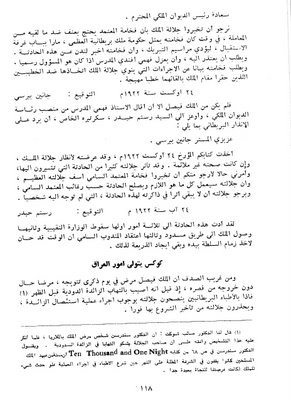
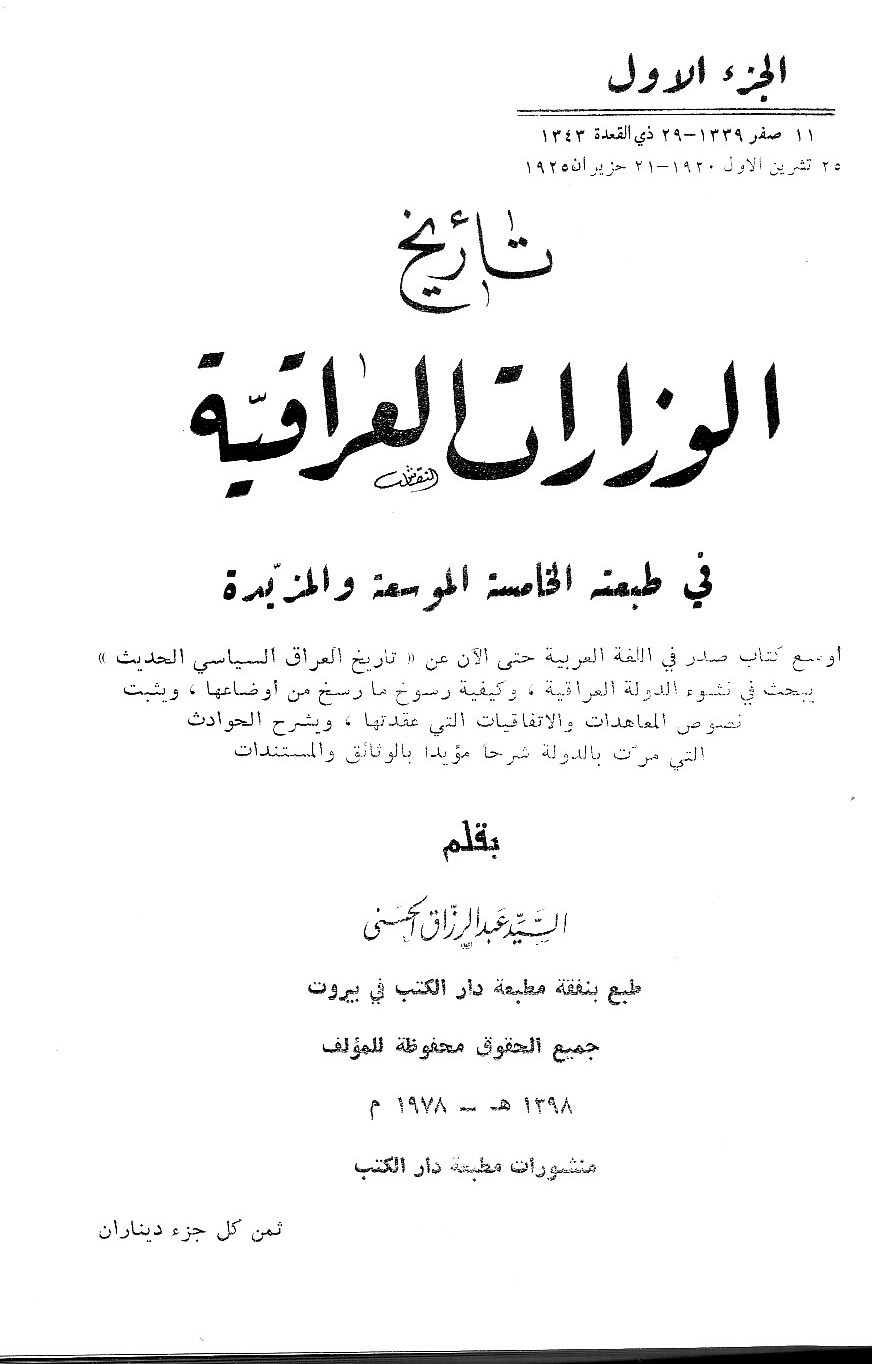
The Book Cover and pages 118 and 323 of Abdur-Razzaq Al-Hasani's
book, "ta'reekh al-wizaraat al-Iraqiyya" providing the
date of King Faisal I's appendectomy in August 1922 (page 118) and the date of
the King's death and who accompanied him to Switzerland (page 323).
^^^^^^^^^^^^^^^^^^^^^^^^^^


IRAQ History E-Newsletter
Bi-Monthly
April 2006


Inside This Issue


1. Iraqi Society During the Late Ottoman Era
By Anees Al-Qaisy


2. Iraq's Kings and Leaders Part 1
http://iraqshistory.blogspot.com/2006/01/kings-presidents-last-jews-in-baghdad.html  


3. Iraq's Kings and Leaders Part 2
http://iraqshistory.blogspot.com/2006/02/iraq-kings-leaders-ii-announcements.html  


4. Iraq's Kings and Leaders Part 3
Compiled and Translated by Wafaa'

5. Important Announcements

6. Acknowledgement


(*_*)


1. Iraqi Society During the Late Ottoman Era
- Characteristics, Loyalties and Perspectives
By Anees Mahmood Al-Qaysi,
Faculty of Arts, History Department, University of Baghdad
anisalkaysi@yahoo.com


This study focuses on the important topic on whether Iraq, in its distinct demographic constitution, was similar to the states of the Arab east, namely Syria and Egypt, which were witnessing an intellectual and national awakening during this period?

During the later Ottoman era, Iraqi society of a distinct nature, given that it was varied in its religious and ethnic makeup. There were Moslems, Jews, Christians and other religious groups, and there were also Kurds, Turkmans and other ethnic groups. This religious and ethnic composition impacted the crystallization of the Iraqi culture. It may be attributable to the policy followed by the Ottoman state towards the various segments of the Iraqi society.

The Ottoman state, as is known, relied upon the Sunni segments of Iraqi society. It allowed them to establish schools and to obtain state positions and to serve in the army. Hence, they had a greater opportunity than the Shiites in holding important state posts due to their support for the Ottoman state, which in turn availed them of the opportunity to get a better education. In effect, they dominated intellectual life and got the lion's share of governmental positions. The pan-Islamic policy of Sultan Abdul Hameed II contributed to strengthening this privileged position among the Sunnis, whose aim was to reinforce allegiances to the Ottoman state, while the Shiites who were districted from governmental positions and were prevented from opening schools. The Ottoman state did not recognize the Shiite religious authorities. This contributed to the increase in the rate of illiteracy among Shiites and the prevalence of superstitious beliefs, in contrast with the Sunnis who had a better education and so were secular in appearance and were Ottoman in culture. This policy led to a great increase in the role of the Shiite mujtahids (jurists) in Iraq, a majority of whom was of Persian orientation. They provoked both the Iraqis and the Ottoman state.

As for the remaining segments of the Iraqi society, such as Jews, Christians and others, they enjoyed special privileges in accordance with the Ottoman reforms and, also, in accordance with the foreign privileges. This led to their becoming autonomous in their religious and judicial affairs. The Jewish population focused on banking and economic activity, while the Christians focused on owning land and other properties, and they had schools, which were supported by western missionary institutions.

Iraqi society was and still is religiously and ethnically diverse. Although this diversity is for the most part positive and it did not prevent the flourishing of cities like Baghdad, Najaf, Karbala and Basra, Iraqi society remained non-cohesive, which made the penetration of western cultural and commercial interests in Iraq abundantly possible, and in turn deepened the rift between the segments of Iraqi society.

After the Turkish coup d'etat of 1908, the concept of Turkification, which was pervasive in Iraq, was substituted for the concept of Ottomanism. In fact, Turkification was the main impulse for the emergence of Arab nationalist movement (Qawmeyyah) in Iraq prior to World War I. However, this movement was exclusively restricted to the Sunni segment that was supportive of the Ottoman state. As for the Shiite segment of the population, it had a national sentiment (Wataneyyah) more than a pan-Arab feeling. This was clearly displayed in the 1920 revolution.

In brief, Iraq was not a favorable environment for the emergence of the nationalist idea as was the case in Syria and Egypt.


Note: This is an abstract from a 35-page study entitled, "Iraqi Society During the Later Ottoman Era: Characteristics, Loyalties and Perspectives"


4. Iraq's Kings and Leaders Part 3
- Compiled and Translated by Wafaa'


The era of King Faisal I was featured in part 1 of this series. The information later sparked a prolonged debate among few Iraqis about some of the puzzling and unknown aspects of his life and especially his death. In this part of the series, King Ghazi's era is highlighted. As mentioned in part I, King Faisal I was enthroned as the King of Iraq on August 23, 1921. He became ill suffering from appendix pain on the same day (August 23) one year later (1922). The British doctors advised him to undergo appendectomy.


All sources agree that King Faisal I died in Berne, Switzerland in 1933. But not all sources agree on the exact date and the way the king had died. Some state that December 8 was his death date, others indicate that it was in September. The latter is accurate because his son, Ghazi, became the king in September. King Faisal died on September 7, 1933.  Some sources indicated that as he was with Nuri As-Saeed and Rustum Haidar in Switzerland for a treatment, he suffered a sudden heart attack!

". . . with the untimely death of King Faisal, Iraq became like a ship without a captain. With the accession of King Ghazi to the throne in September 1933, the country became prey to military coups and tribal uprisings." King Ghazi inherited none of his father's diplomacy especially with the tribes. He was young and inexperienced, a situation that weakend the monarchy politically and encouraged the army to penetrate in politics.


Majid Khadduri, in his book "Independent Iraq" (2nd edition) stated that:


"The disillusionment of the army officers was reflected in voicing certain grievences such as that the army was excessively used to put down inspired tribal uprisings, while the politicians were to gain the fruits of victory. Why should not the army itself, it was whispered among the army officers, put an end to the quarrel and vices of the politicians and rule the country through a military dictatorship? "


The first problem faced King Ghazi was that of his marriage. He liked a lady by the name of Nimat (daughter of Yaseen Al-Hashimy) who was a friend of his sisters. Nuri As-Saeed (former Prime Minister until 1932) interfered because he did not want his opponent, Yaseen Al-Hashimy, to have the royal prestige and be called 'uncle' by King Ghazi. Nuri even requested the mediation of Prince Abdullah of East Jordan. He wanted him to marry his (first) cousin, Alia, who was living in Istanbul. After numerous attempts and prolonged pressures, King Ghazi married Alia Bint Ali on January 25, 1934.


King Ghazi's reign witnessed revolts and coup attempts in 1934, 1935 and 1936. In all of these events, the army enforced the law and order.


After resigning from his post as a Prime Minister, Nuri As-Saeed sought to return to power. Details on how he came back to power will be tackled in part 4 of this series. He became the Prime Minister in 1939, which was an exceptionally eventful year. The situation in Palestine was continuously deteriorating. During this year, the Palestine Conference took place, King Ghazi was killed and World War II began. Concerning the first event, it had become evident that the Jews wanted an independent state, which was a matter rejected by Arabs.


In March 1939 following Nuri’s return from the Palestine Conference, he became aware of an army plot, and so he was determined to overthrow King Ghazi. Nuri informed the King and the British Ambassador, Sir Maurice Peterson, that the fifteen-officer plot was connected with the ex-Prime Minister, Hikmat Sulaiman. In a telegram to the Foreign Office, Sir Peterson referred to these officers as ‘Bakr Sidqi’s Gangsters’. Sulaiman was arrested with the other officers and were sentenced to death. All the death sentences were later converted to long-term imprisonments.


“In Iraq the plot was widely seen as a fabrication by Nuri in order to avenge for Jaafar Al-Askari’s assassination (his brother-in-law) by Hikmat and Bakr entourage.”


The sudden death of King Ghazi came as a shock. He was killed in a mysterious car crash in the evening of April 3. His death was announced on the 4th. The mystery of his death can be summarized by the testimonies of those who were at the scene of the King’s death or have witnessed statements that can be argued as a motive for the King’s killing:


1. Rasheed Ali Al-Gailany,
When I learned of the accident from Nuri As-Saeed, I went immediately to the Palace. There, I saw Doctor Sanderson working to cover the injured spot with gauze. I saw his injury, it was located in the rear of his head. Because the car was said to have hit an electric column, I expected it to hit the King’s head from the front.”


2. One of the Palace’s employees indicated that,
The royal family’s primary physician arrived an hour after the accident, and the rest of the doctors arrived later. Nuri As-Saeed was the first to arrive in the Palace and joined Queen Alia and Prince Abdul Ilah."


3. Tawfeek As-Swaidy,The Deputy of the British Foreign Ministry complained vigorously about King Ghazi’s behaviors as he publicly discussed the issue of Kuwait on his radio station from al-Zuhoor Palace."


King Ghazi was seen by his people as a nationalist hero for his suppression of revolts, his claim on Kuwait (which used to be part of Iraq before the British annexed it), his support for the Palestinian cause and his anti-British broadcasts from al-Zuhoor Palace’s radio station, which he established as a result of his love for radio broadcasting.


Sources:
1. "Independent Iraq" by Majid Khadduri [2nd edition], London 1960, pages 77-78
2. "Rashid Ali al-Gailani -- The Nationalist Movement in IRAQ 1939-1941 " by Walid M. S. Hamdi, London 1987
3. "Al-Iraq -- Shahada Siyaasiyya 1908-1930 " by Hussein Jameel (in Arabic), London 1987
4. " Al-Iraq -- Hawamish Minat-Tareekh walmuqaawama " by Abdur-Rahman Muneef (in Arabic), Lebanon and Moracco, 2004
5. " Tareekhul Wizaaraatil Iraqiyya -- Part I " [5th edition] by Abdur-Razzaq Al-Hasany (in Arabic), Baghdad 1978

-----------------------

5. Important Announcements
** Iraqi Women Historians are needed to join the writing/editing team to participate in the writing and editing of this IRAQ History e-newsletter. The candidate must posses a Masters degree with teaching experiences in Iraqi history and/or have been writing and publishing in the field. Please submit a biography and contact information by emailing it to historyofiraq@gmail.com


** Swiss-Arab Cultural Center **
http://www.sakz.ch/


The 6th International Poetry Festival al-Mutanabbi    2006
From May 13 to May 20, 2006, in Zurich, Lucerne, Berne, Geneva and Lugano

In 2006 the “International Poetry Festival al-Mutanabbi” takes place for the sixth time. This is also the highlight of the regular events at the Swiss-Arab Cultural Center in Zurich. In Switzerland and Europe it is now the only poetry festival that has allowed the intercultural dialogue with Arabic poetry since its foundation in 2ooo.

After five years of existence the 6th “International Poetry Festival al-Mutanabbi” expands its programme to the three great language areas of multicultural Switzerland. This year, between May 13 and 2o, 2oo6, the eight multilingual festival readings and the panel discussion take place in the five cities of Zurich, Lucerne, Berne, Geneva and Lugano.

The theme of the 6th “International Poetry Festival al-Mutanabbi” 2006 is “Poetry and Politics”. The panel discussion about this year’s festival theme will be held at 12 o’clock on Sunday, May 14, 2006, in the Swiss-Arab Cultural Center in Zurich. It will deal with political subjects such as tolerance, democracy, human rights, equality, freedom, and other social topics that also form the subject of both oriental and occidental poetry.

From May 13 to May 20, 2006, Arab authors such as Murid Al-Barguti (Palestine), Helmi Salem (Egypt) and Kadhem Al-Hajaj (Iraq) meet Swiss colleagues, among whom Kurt Aebli, Sabine Wang, Kathy Zarnegin, José-Flore Tappy, and Alberto Nessi, and international writers such as Adnan Özer (Turkey), Daniel Leuwers (France), Matthew Sweeney (Ireland) and Luisa Castro (Spain), as well as Robert Schindel (Austria) and Ernest Wichner (Germany).

The festival readings are from Saturday, May 13, to Monday, May 15, at 8 p.m. at the Culture Market Rats (Zwinglihaus) in Zurich; on Tuesday, May 16, at 8.3o p.m. in the Old Casino in Lucerne; on Wednesday, May 17, and Thursday, May 18, at 8 p.m. in the Dampfzentrale in Berne; on Friday, May 19, at 8.3o p.m. in the Société de lecture in Geneva, and finally on Saturday, May 2o, at 9 p.m. in the Hotel Pestalozzi in Lugano.

The Poetry Festival “al-Mutanabbi” enjoys a good international reputation. We’ll be glad to have you as our guests at the 6th “International Poetry Festival al-Mutanabbi” in Switzerland. We’re at your disposal to answer your questions.


Zurich, May 21, 2006 (UNESCO Worldwide Poetry Day since 2000)


Al-Mutanabbi
(915-965 CE)


Abut-Tayyib Ahmed al-Mutanabbi was born in 303 Hijriyya (HJ)/ 915 CE in an area called Kinda in the City of Kufa (in today’s IRAQ). He had a rare talent in versifying poetry with no competitors in his lifetime!


He was given the family name of al-Mutanabbi because he claimed to be a prophet (Nabiy) while in the Samawa desert.


Abut-Tayyib traveled to Aleppo, Damascus and various cities in Egypt. In 350 HJ, he returned to Baghdad. Then traveled to Arjan and then to Shiraz in Iran, and finally arrived in Baghdad. In the early month of Shaaban, 350 HJ / 965 CE, he traveled to Kufa. While he was on the road in Kufa accompanying his son and a friend, a group of men passed by and harassed al-Mutanabbi. They mocked and challenged him into fighting. As a result of the fighting, al-Mutanabbi, his friend and son were all killed.


Al-Mutanabbi was the master of the exuberant panegyric, which is impossible to translate into adequate English. His (Diwan) collected poems are famous for their long-lived qasida. With a flowery style and changing away from the traditional Arabic qasida, Al-Mutanabbi stands out as the most important representative for the panegyric poetry.


For further reading and sources, visit http://www.poetrymagic.co.uk/poets/almutanabbi.html
(-------------------)


6. Acknowledgement

Many Thanks go to Abdul Kareem Hani for providing the pages from Abdur-Razzaq Al-Hasani's book, and to Wasan Sadiq for providing the pages from Majid Khadduri's book. Had it not been for the gracious help of many members of the Iraqi community in providing historic information, these IRAQ History e-newsletters wouldn't have become a reality.

Tuesday, March 28, 2006

Excerpts from Uriel Dann's Book on Qassim


Paragraphs Related to OIL Under Qassim

Pages 354-355

On December 11, 1961, the government approved Law No. 80 “For the Definition of Exploitation Areas.” This curtailed the concession area of the oil companies by more than 99 per cent, namely to about 800 square miles undergoing exploitation, with provision made for a reserve, also of 800 square miles.

The oil companies protested against the new legislation, but did not dispute its validity. They demanded arbitration. However, they handed over to the government their technical data on the unexploited areas, in accordance with a provision of the law. Meanwhile, British and United States representatives interceded for the companies and asked for a renewal of negotiations. The Iraqi government rejected their proposals, which were condemned as “interference” from outside. The request for arbitration was ignored.

Nevertheless the law had no further practical consequences. Having come perilously close to brink, the two sides reined in. Qassim had never contemplated surrendering the annual ID 100 million in royalties for oil he knew he could not sell outside the West, and on which the government of the country depended. Nor did the oil companies intend to stop a profitable business while Qassim’s vagaries – unpleasant, costly and possibly auguring ill for the future – entailed no crippling damage for the present. The output of oil, at any rate, never suffered.

A National Oil company was envisaged to exploit the areas over which foreign companies’ concessions had been cancelled. The draft of enabling law was published in September 1962. It was due for promulgation early in February 1963, but Qassim’s regime met its end first.

The contest with the “imperialistic” oil companies received the enthusiastic support of the Iraqi newspapers at every phase. Their constant baiting may have encouraged Qassim, or may equally have been an embarrassment, impeding his freedom to maneuver.

There is no doubt that his handling of the oil negotiations and their aftermath did Qassim great damage with the West. The original British view that he was a match for the communists, and in the circumstances the least undesirable of possible regimes for Baghdad, had slowly been gaining ground in the United States. Now, as a communist takeover was no longer an imminent danger, Qassim had shown himself viciously ill disposed to the West. He had become expendable on positive as on negative grounds.


Glossary

Baiting: Lure, attraction يغوي ، يغري
Curtailed: Shortened
Contemplated: Considered, planned.
Disposed: Willing, ready
Envisaged: Imagined
Expendable: Disposable, unessential مستهلك ، غير ضروري
Imminent: About to happen
Impeding: Obstructing, delaying يعوق
Maneuver: Plan  خطة  
Promulgation: Broadcast, circulation


Book Title: "Iraq Under Qassim - A Political History, 1958-1963," written by Uriel Dann, published by Fredrick A. Praeger, Inc. (USA) and Pall Mall Press (UK) in 1969.

Tuesday, February 28, 2006

IRAQ's Kings and Leaders II - Announcemments


IRAQ History Monthly E-Newsletter


February 2006

Inside This Issue:

1. IRAQ’s Kings & Leaders Part II
2. Important Announcements
3. Introducing The Historians Behind This Newsletter
4. The Purpose of These Monthly E-Newsletters & How To Join This Group List


(*_*)

1. IRAQ’s Kings & Leaders - Part II

Compiled & Translated to English by Wefa M. S.

Part 1 of this series, which was published in the January e-newsletter, featured King Faisal I (1885-1933)   https://iraqshistory.blogspot.com/2006/01/kings-presidents-last-jews-in-baghdad.html
 
An interesting debate began following the article's publication and emailing of part I to the IRAQ History group list, which focused on the way King Faisal I had died. One of the previous subscribers to the list indicated that the death of the king was not due to a strange heart attack shortly after drinking a cup of tea, but it was due to an appendectomy surgery in Switzerland in 1933. However a couple of sources indicated that the appendectomy surgery took place in the early 1920s in Iraq by a British doctor.
 
The Kings & Leaders series is not published chronologically.
 
 
Abdul Kareem Qassim (1914-1963)

Qassim, the first Prime Minister of the Iraqi Republic, was born in the Mahdiya part of the city of Baghdad. His siblings, in order of birth, are:
1. Hamid Qassim Mohammed al-Bakr (1905-1986), worked in commerce.
2. Abdul~Lateef Qassim (1907-1977), worked in the army as deputy officer who retired in 1959.
3. Ameena Qassim (1909-1983), housewife.
4. Najiyya Qassim (1916-1986), housewife whose husband was the general Abdul Jabbar Jawad (brother of the colonel pilot Mohammed Ali Jawad).


Qassim’s parents, according to an official document published while he was in office, were of pure Arab descent: His mother originated from the Adnan clan and his father from the Qahtan clan. However, many reliable sources indicate that his mother was a Shiite (Faily) Kurd. Qassim never married.

When he was six years of age, the family moved to Suwayra, a small town near the Tigris. Then moved to Baghdad in 1926. Qassim was an excellent student; he entered secondary school on a government scholarship. After his graduation in 1931, he taught at the Shamiyya Elementary School. He began his teaching on October 22, 1931 and resigned on September 3, 1932. His resignation was due to the fact that he was accepted into the Military College. In 1934, he graduated as a second lieutenant. Then, he attended al-Arkan (Iraqi Staff) College and graduated with honor (grade A) in December 1941. In 1951, he completed a senior officers’ course in Britain.

Militarily, he participated in the suppression of the tribal disturbances in the Middle Euphrates region in 1935, in the one-month war against Britain in May 1941 and in the Kurdistan war in 1945. Qassim also served during the Iraqi military involvement in Palestine from May 1948 to June 1949. Toward the latter part of the Palestinian mission, he commanded a battalion of the First Brigade, which was situated in the Kafr Qasem area south of Qilqilya. He left Kafr Qasem with the reputation of a disciplinarian, meticulous and honest. In 1956-57, he served with his brigade at Mafraq in Jordan in the wake of Israel’s Sinai campaign against Egypt.


The End of the Monarchy (July 14, 1958)

Prince Abdul Ilah objected to any resistance to the forces that besieged the Royal Rihab Palace. His hope was to gain permission to leave the country. Therefore, the commander of the Royal Guards battalion on duty, Col. Taha Bamirni, ordered the palace guards to cease-fire.

It was a little after 7 AM when all the royal family descended: King Faisal II; the Crown Prince Abdul Ilah; Princess Hiyam, Abdul Ilah's wife; Princess Nafeesa, Abdul Ilah’s mother, with the Qur'an in her hand; Princess Abadiya, the king’s aunt; and several servants. When all of them arrived in the courtyard they were told to turn towards the palace wall, and were all shot down by Captain Abdus~Sattar As~Sab’ with a sub-machine gun.

King Faisal II
and Princess Hiyam were injured
. The King died later before reaching hospital. Princess Hiyam was treated at the hospital and luckily no one recognized her. Later she left for Saudi Arabia where her family lived and then moved to Egypt until her death.

The coup was discussed and planned by the Free Officers, but was mainly executed by Qassim and Col. Abdes~Salam Aref. By 1956, the committee of Free Officers included; Qassim, Naji Talib, Abdul Wahab Ameen, Muhiddeen Abdel Hameed, Abdes~Salam Aref, Abdul Wahab Ash~Shawwaf, Abdul Kareem Farhan, Rifat al-Hajj Sirri, Col. Tahir Yihya, Rijab Abdul Majeed, Wasfi Tahir, Col. Sabeeh Ali Ghalib and Mohammed As~Sab’.

The killing of the entire royal family was a gloomy start in Qassim’s era. His enemies accuse him of giving orders to kill the royal family. However, this was untrue. Qassim did not give orders to kill the King, never mind the entire family. It was a spontaneous decision made by Abdus~Sattar As~Sab’ and two others (I could not find their names). As~Sab' committed suicide later in Basrah. Despite that Qassim did not give orders to kill the king, not condemning the aggression against the royal family in his early speeches was a mistake.


Accomplishments

Qassim’s accomplishments were many covering a large range of improvements with regard to social services, legal system, agriculture, health and education, construction and the arts. Considering his short-term leadership (four and a half years) and the youngest experience in the life of the Iraqi Republic, Qassim’s era brought the highest number of accomplishments and positive changes to Iraq compared with eras that preceded and followed him.

Some of these achievements were the passing of law No. 80 which took back the right of owning 98% of Iraqi land from the British-owned Iraq Petroleum Company, distributing fairly the farms owned by the few among the farmers, and, as a result of the two achievements, increasing in middle class percentage and privileges, the building of 35,000 residential units to house the poor and low middle class, the rewriting of the constitution for the benefit of all Iraq’s minorities and women, effectively encouraging and implementing laws with regard to women’s participation in the society, and giving birth to many other improvements, laws and projects pertaining literacy, education and the arts.

His accomplishments and successes in the Arab world’s scene can be summarized by his continuous moral and financial support to Algerians and Palestinians in their struggle for self-determination. In addition, Qassim succeeded in the struggle against Abdul Nasser of Egypt. “No doubt the fact that he had incurred Abdul Nasser’s displeasure weighed against Qassim’s position. But in the direct contest Abdul Nasser was thwarted; he grudgingly acknowledged his defeat, just as he has since acknowledged defeat against other opponents in the Middle East arena.”1


Qassim’s Last Moments:

The coup to overthrow Qassim by the Baathists was successful on February 8, 1963. Abdul Kareem Qassim was brought to the Broadcast Building on February 9 by his opponents. He was not awarded a fair trial. Qassim was executed at noon on February 9th, 1963.

The names and fate of the Iraqi collaborators who ruthlessly murdered Abdul Kareem Qassim are as follows:

1. Abdus~Sattar Abdullateef, died in early 2005 in Spain.

2. Abdus~Salam Aref, president of Iraq after the assassination of Qassim, died in 1966 in an airplane crash believed to be orchestrated on purpose.

3. Ahmed Hasan al-Bakr, president of Iraq from 1968 to 1979, who was, believed to be, killed by orders from Saddam Hussein.

4. Hardan At~Tikreeti, Minister of Defense who was killed by the Baathist secret intelligence in Kuwait.

5. Ali Salih As-Saadi, Deputy Prime Minister, died of sickness with rumors of being killed with poison.

6. Hazim Jawad, lived in the UAE, is currently living in London. His memoir was published in the al-Quds al-Arabi newspaper http://www.alquds.co.uk/.

7. Talib Hussein Shabeeb, was a Foreign Minister & Iraqi Ambassador, then joined the Iraqi opposition against Saddam Hussein. He died in 2004.

8. Hani al-Fukaiky, Baath member and worked in commerce, later joined the Iraqi opposition against Saddam. He died of cancer in 2000.

9. Saleh Mahdi Ammash, Baath member, whose last post was Iraq's ambassador in Finland.

A radio clip (in Arabic) of the last moments in the life of Qassim can be heard by clicking on http://zennobia.blogspot.com/2006/02/abdul-kareem-qassim-last-moments.html It narrates and includes the argument that went on between the nine individuals (listed above) and Abdul Kareem Qassim, which lasted about ten minutes and ended with a violent shower of bullets shot at Qassim, al-Mahdawi and al-Shaikh Ahmed.

That radio clip features a commentary by the Kuwaiti broadcaster, Najm Abdul Kareem, who aired it on London’s Radio Spectrum, the Arabic Broadcast in 1999. The recording of the argument that went on between Qassim and those (mentioned in the list above), who executed him, was unclear. After writing and posting this article and the radio clip on the Internet, I became aware of the fate of the individuals who witnessed and/or participated in the killing of Qassim. Please note that the radio clip does NOT provide accurate details about some of the individuals who were present at Qassim's execution.

The radio clip;
1. Does not mention an important person, Saleh Mahdi Ammash, who was present and gave orders to execute Qassim.


2. It mentions that Tahir Yihya was present, but he was not. The broadcaster even indicated that Tahir Yihya was executed while in prison, which was not true.


3. Because the clip aired in 1999, the fate of some of the individuals who were present at Qassim's execution has been updated in the list above.


Abdul Kareem Hani, former minister of labor and social affairs as well as a close friend of Tahir Yihya wrote, "Tahir Yihya, was imprisoned and later freed (unlike what the broadcaster had stated in the radio clip). Tahir Yihya was put under house arrest after being released from prison; he was not indicted nor sentenced. I visited him many times after his release. Then he had a stroke with hemiplegia and loss of speech, which lasted till his death."

According to Col. Ali Hussein Jassim, London-based member of the Royal United Services Institute, Tahir Yihya and Abdul Ghani Ar-Rawi were not present at the February 9th execution of Qassim. Col. Jassim was a witness (not a collaborator) during the execution. Ali H. Jassim provided the information regarding the presence of Saleh Mahdi Ammash and the fate of both Hani al-Fukaiky and Talib Hussein Shabeeb.


Main Reasons WHY the CIA Overthrew Qassim

1. The Passing of Law No. 80, which took back the right of owning 98% of Iraqi land from the British-owned Iraq Petroleum Company (IPC) and giving it to the Iraqi National Oil Company (INOC), baring in mind that the British right to the Iraqi land was for life and without relinquishment.


2. Disclosing interests to bring back Kuwait within IRAQ the way it used to be before British colonization, an interest was also disclosed by King Ghazi (1933-1939) who was killed by the British and by Saddam Hussein who was hanged in December 2006 by the USA!
3. Qassim's political neutrality and popularity among Iraqi people while still allowing political freedom for Iraqis to enjoy was a matter the USA-UK collaborative never wanted to see in an oil-rich country.


The following was not a reason, but an excuse provided to the public to justify killing him:

Qassim
was accused of being a communist. He was not. In fact he belonged to no political party unlike the presidents who succeeded him. Additionally, he made no attempt to form his own political party. He gave freedom to most political parties to exercise their activities. His actions were backed up by some speeches in which he emphasized numerous times that the army must be above all political party affiliations.


Footnotes:

1. "Iraq Under Qassem - A Political History 1958-1963" by Uriel Dann, published by Frederick A. Praeger, Inc. USA in 1969 page 377.


Sources:

1. "Iraq Under Qassem - A Political History 1958-1963" by Uriel Dann, published by Frederick A. Praeger, Inc. USA in 1969.

2. Talib Qassim, nephew of Abdul Kareem Qassim, currently living in the UAE

3. "The Secrets of the July 14, 1958 Revolution", by Ismael al-Aref, published by Al-Majid Publishing Co. in London, 1987. (in Arabic language)


///////////***********(*_*)************\\\\\\\\\


2. Important Announcements:

* The IRAQ History e-newsletter will be published and posted on bi-monthly bases. This is to ensure better quality e-newsletters and diverse participation. This is also to allow more time until the next issue to find additional Iraqi historians living outside of IRAQ who are able to participate more conveniently in the writing of IRAQ's history and in the discussion of this group list. Therefore the next issue will be published and emailed in April.

* We welcome Amer Fattuhi to the Research/Translation Team. Amer Fattuhi is an artist and a researcher whose focus is on the ancient history of IRAQ (BCE). He has published a book and numerous journals on the history of Chaldeans. He currently lives in Detroit, MI.

* We welcome May Tawfik to the Research/Translation Team. May has worked in social research in the Babel College for Theology and has participated in the reasearch and documentation of the ancient history of Arameans in Iraq. She currently lives in IRAQ.


3. Introducing The Historians Behind This Newsletter


http://historyofiraq.blogspot.com/2005/12/iraqhistory-e-newsletters-contributors.html


4. The Purpose of the IRAQ History Monthly e-Newsletters & How to Join the Group List!

This group focuses on documenting and discussing various fields in IRAQ's history (politics, sciences, religions, law, the arts and other areas). The IRAQ History Group consists of a Writing/Editing Team made of historians and scholars and of Translating/Research Team made of researchers and translators (translating to English). The group's e-newsletters will be sent to the group list subscribers on bi-monthly bases.

The purpose of the group list goes beyond documenting to encourage discussions on regular (not daily) bases and the exchange of information and announcements. Those interested in learning about and/or in discussing IRAQ's history are welcome to subscribe, but subscribing to the list does not mean participation in the writing/editing of IRAQ's history. These e-newsletters will eventually be posted on a special website/blog for Internet use. We hope to receive grants/contributions to be able to compensate historians/scholars of the writing/editing team should we invite them to participate in events related to IRAQ's history or for writing essential studies/essays for the purpose of publishing them in journal/book forms and not placed freely on the Internet.We appreciate your recommendation of four Moslem and non-Moslem Iraqi women historians to join the writing/editing team.

The IRAQ History Group List was initiated and launched by Wafaa', writer, translator and an art researcher and critic.

Writing/Editing Team (in First-Name Alphabetical Order):

Prof. Abdul Jabbar Naji

Anees Al-Qaisy

Dr. Mahmood Al-Qaisy

Nahar Mohammed Nuri

Ms. Saba Hussein Al-Moula

Dr. Sinan Sadiq Az-Zaidy

Dr. Suhaila Shindi Al-Badri

Tariq Majeed

Translation/Research Team:

Hanan Mohammed Mahdi
Wafaa Mahmood, IRAQ History Group List Moderator